
Sex Offender Checks in Madison County
The Alabama Law Enforcement Agency maintains the central Alabama Sex Offender Registry under the Alabama Sex Offender Registration and Community Notification Act, often shortened to ASORCNA. Local agencies register and verify people subject to the law, then send updates to ALEA. The state says those submissions update the central repository daily in real time. In Madison County, the Sheriff's Office registry route performs the local role and also provides county list and map access.
Three official online layers serve different needs. The ALEA-linked state portal is the core Alabama source. The Madison County list and map offers a local view with profile links. The U.S. Department of Justice NSOPW search helps when an address, person, or travel pattern crosses state lines. The sheriff's phone line is the non-web fallback. No single view should be read beyond the facts it actually displays.
Madison County Registry Map View
The official Madison County offender list and map supports list and map navigation with links to individual profiles. The local display may also identify homeless status. Its warning matters: an address may be inaccurate when a person has failed to report a change. A map marker is a lead for awareness, not proof that a person is present at that spot at a given moment.
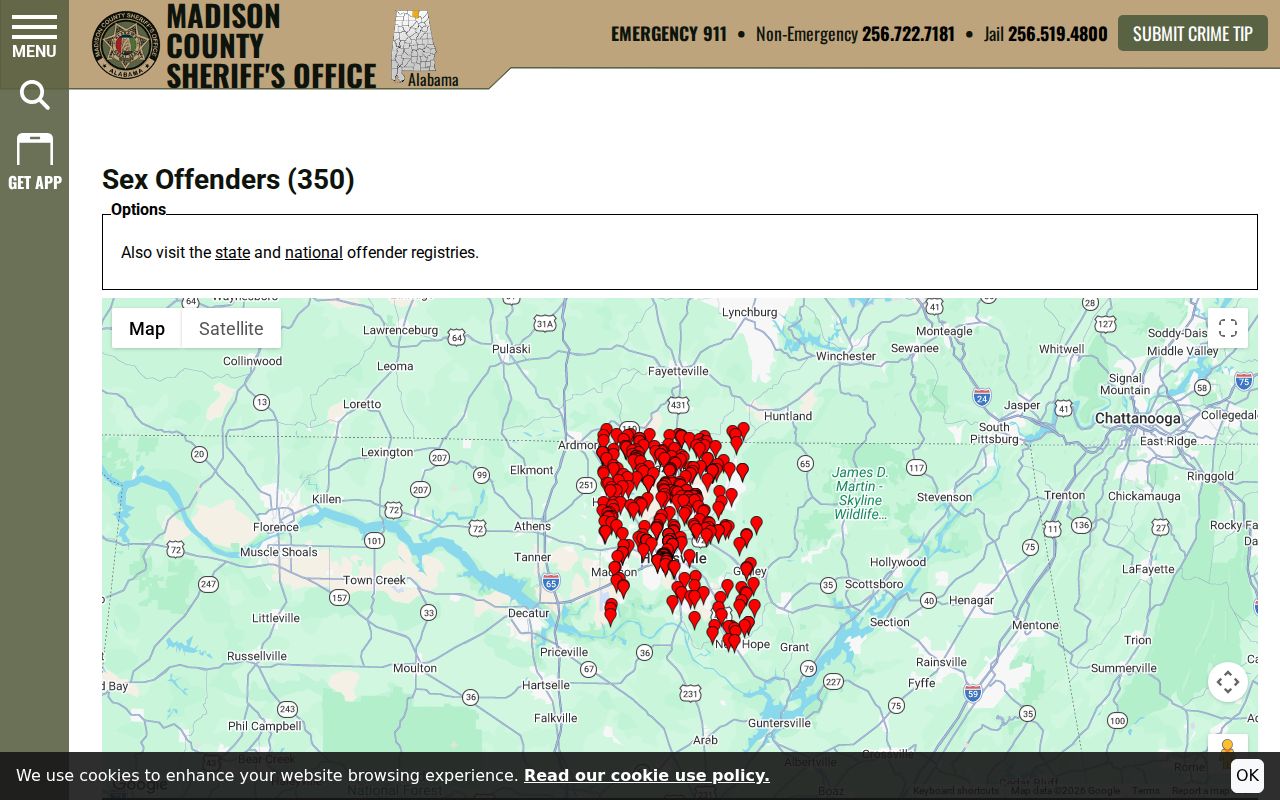
The list/map interface helps frame a local search by place. Open the official profile before drawing a conclusion, compare physical details, and report a suspected wrong or prohibited address to law enforcement. Do not go to the location to investigate.
How to Search the Alabama Sex Offender Registry
Start from ALEA's official registry information page and follow its public-search route. The vendor form blocked automated inspection during research, so unverified input labels are not claimed. Use the controls visible in the live official interface, read its terms, and limit the first query enough to avoid false matches. Then compare the result with the county source.
- Open the ALEA registry route and review the stated conditions for public use.
- Enter only the search facts the live form requests and that you can verify, such as a known name or location shown by the current interface.
- Compare the result list carefully. Do not rely on a name alone when physical details or an address can distinguish records.
- Open the full profile, compare it with the Madison County list or map, and contact the sheriff about a suspected reporting problem.
The verified Madison County controls and access routes are summarized here without inventing fields that could not be inspected.
| Control or Channel | Type | Use | Verified Note |
|---|---|---|---|
| State public search | ALEA-linked portal | Alabama registry query | Current form labels must be read live |
| County list | List view | Browse local entries | Opens official profile links |
| County map | Map view | View local geographic context | Address accuracy warning applies |
| Profile link | Detail view | Check displayed identity and offense fields | Not every possible field is published |
Madison County Registry Verification
ALEA maintains the portal, but Madison County verifies local registration information. Registrants generally report address and employment changes to the local agency. They also appear during their birth month and every three months after that for a current photo and fingerprints. These duties explain why a public profile may change as the sheriff submits new information to ALEA. The state describes its central update as daily and real time from local submissions. That means the public profile still depends on the report reaching the local office first. A stale address should be reported through law enforcement so the agency can check facts that a public user cannot see.
Madison County does not publish a dedicated registration-counter address and schedule on the reviewed registry page. The Sheriff's Office has its main administration at the Madison County Courthouse, but that does not establish where registration appointments occur. Call 256-532-3412 before making an in-person trip. The state Sex Offender Unit can be reached at 334-676-7898 or sexoffenderunit@alea.gov. Those contacts are the right channels for process questions. A public user should never attempt a personal compliance check.
Madison County Sheriff's Office
Local registration and verification
256-532-3412
Call first for the correct counter and current hours.
Inside a Registry Profile
An anonymized Madison County profile inspection showed the public fields below. The inspection retained no person's identity or values. Use several matching details together. A portrait and physical description can help separate people who share a name, while the offense statute explains the legal basis for the entry.
| Name | The displayed full name. Aliases were not shown in the inspected local profile. |
|---|---|
| Photo & Description | Portrait, gender, hair, eyes, height, weight, and race. |
| Registered Address | Street, city, state, and ZIP, or homeless status where the list supplies it. |
| Birth Information | Date of birth appears in the inspected profile and should be used with other identifiers. |
| Offense | Offense statute and description associated with the public registration record. |
| Not Observed | No public tier badge, vehicle, employer, school, scars, tattoos, separate compliance label, or verification date was observed. |
A missing field does not prove that the fact does not exist in agency records. It means the sampled public Madison County profile did not display it.
Madison County Offender Identity Checks
Name-only matching creates a high risk of error. Compare the portrait, date of birth, physical traits, full displayed address, and offense description. Even then, treat the profile as a public registry record, not as a broad criminal history. The inspected Madison County profile did not display aliases or vehicles, despite such fields appearing in some registry systems elsewhere. Do not assume they are available here.
An address deserves equal care. A local list can show homeless status, and the sheriff warns that failures to report can make address data inaccurate. If an entry appears stale, document the official profile link and contact law enforcement. Never visit the address, confront the person, question household members, or post claims based only on a map pin.
Alabama Registration Levels and Requirements
Alabama does not reduce public registration to an ordinary Tier I, II, and III badge. ASORCNA instead ties duration and public treatment to adult, juvenile, Youthful Offender, offense, and risk provisions. Adult registrants generally report for life, while distinct juvenile rules can create ten-year or lifetime periods. Verification is generally during the birth month and every three months, but public display depends on the statutory category.
| Alabama Category | Duration | Public Treatment |
|---|---|---|
| Adult sex offender under ASORCNA | Generally lifetime | Public display subject to statutory exclusions |
| Juvenile age 14+ for an enumerated serious offense | Lifetime; relief petition may be possible after 25 years | Depends on governing juvenile provisions |
| Other juvenile sex offender | 10 years from first registration | Public treatment depends on statute and risk findings |
| Juvenile assessed high risk | Category-specific | May receive public notification |
| First sexual-misconduct or indecent-exposure conviction | Registration and verification treatment | ALEA says a first conviction is not public |
| Youthful Offender | Depends on applicable exception | Generally not public unless adult treatment applies |
Note: A missing Madison County public result can reflect lawful juvenile, Youthful Offender, or due-process exclusions rather than a search failure.
Madison County Registry Distance Rules
Alabama law generally bars an adult offender subject to the provision from living within 2,000 feet of school property or child care, with statutory definitions and exceptions. That is a legal residence restriction. It is not the same thing as a search radius or the apparent distance between map markers. A public map tool helps users see listed locations, but it does not decide whether a residence complies with every part of ASORCNA.
Questions about a potentially prohibited location belong with Madison County law enforcement. Provide the official profile, the location at issue, and the reason for concern. Officers can check facts that are not public. A map user cannot determine compliance by measuring from a screen or relying on an old address.
Madison County Cross-State Searches
Madison County sits near Tennessee, so a local-only search may not answer a cross-state question. The National Sex Offender Public Website links participating jurisdictions through one federal search layer. Use it when a known address, move, or travel pattern extends beyond Alabama. Then open the originating jurisdiction's official profile for details and current terms.
NSOPW is a fallback and expansion, not a replacement for ALEA or the Madison County sheriff. State laws, profile fields, and public exclusions differ. If ALEA's portal is unavailable, try the Madison County list/map and NSOPW, then call 256-532-3412. Report suspected noncompliance through law enforcement rather than waiting for the web display to change.
Community Notification and Lawful Use
Madison County sex offender registry information is provided for community awareness and safety planning. It can support careful checks of a home area, school route, or another place important to a family. It does not authorize threats, trespass, surveillance, harassment, vigilantism, or illegal discrimination. An address warning also protects against harming uninvolved residents when a registrant moved without reporting.
Use Registry Data Lawfully: Misusing offender information can be a crime under Ala. Code § 15-20A-45 and related ASORCNA provisions. Report concerns to law enforcement and do not confront a registrant or household.
For a wrong address or suspected noncompliance, contact the Madison County Sheriff's Office or ALEA's Sex Offender Unit. Give facts, not assumptions. Emergency threats should go through emergency services. The safest response is official verification.