
Checking Criminal History in Madison County
No single official database contains every Madison County criminal history record. Start with the question the record must answer. The free sheriff roster shows current and recent county custody. Alabama Just One Look provides paid access to filed state trial-court cases. The Madison County Circuit Clerk supplies certified copies, archived searches, and documents that are not available online. A county-only self-check comes from the Sheriff's Criminal Records Division, while an identity-confirmed statewide review comes from the Alabama Law Enforcement Agency.
Gather a full legal name, spelling variants, date of birth when permitted, the arresting agency, an approximate event date, and a case or booking number if known. Those details reduce same-name errors. Follow the record trail in this order:
- Check the Madison County inmate roster for current or recent detention. Call 256-519-4800 if a booking is too new or the roster is unavailable.
- Search a filed state case through Just One Look, or ask the Circuit Clerk Criminal Division about the docket.
- Request the underlying report from the sheriff or municipal police department that created it.
- Use the Madison County-only self-check for a local review of your own record.
- Use ALEA Form 46 when an identity-confirmed statewide record or formal challenge is needed.
Municipal citations and ordinance cases remain with the issuing city court. Federal cases use the Northern District of Alabama and PACER. A search that skips those jurisdiction lines can look complete while missing the exact record at issue.
Madison County Record Offices Compared
Four offices answer four different Madison County criminal records questions. The sheriff creates reports for incidents in its jurisdiction and operates the local records counter. The detention facility creates booking and bond entries. Circuit Clerk Debra Kizer keeps Circuit and District Court files. ALEA assembles fingerprint-linked arrest events and reported dispositions into Alabama Criminal History Record Information, often called CHRI. A dismissal in the court file does not by itself erase the earlier report or booking record.
The official sheriff portal shows how local public tools route to roster, Most Wanted, registry, and records services.

These links lead to separate record products, which is why the office that created the requested file remains the best source.
Sheriff Criminal Records
705 Wheeler Avenue
Huntsville, AL 35801
256-532-3412
Public service generally 8:00 a.m.-4:00 p.m.
Circuit Clerk Criminal
100 North Side Square, Room 217
Huntsville, AL 35801
256-532-3386
Courthouse hours generally 8:30 a.m.-5:00 p.m.
Detention Facility
815 Wheeler Avenue
Huntsville, AL 35801
256-519-4800
Booking information available 24 hours
Alabama Official Background Checks
Alabama does not offer the general public an unrestricted statewide name-search portal. The Alabama Background Check System serves qualifying subscribers. A member of the public reviewing their own Alabama criminal history instead submits ALEA SBI Form 46 with valid identification, an official fingerprint card or AFIS printout, and payment. The standard fee is $25, with each extra copy costing $5. ALEA says to allow at least four to five weeks.
The ALEA criminal-records page separates the restricted subscriber system from the personal review and challenge process, while Form 46 provides the application and challenge fields.
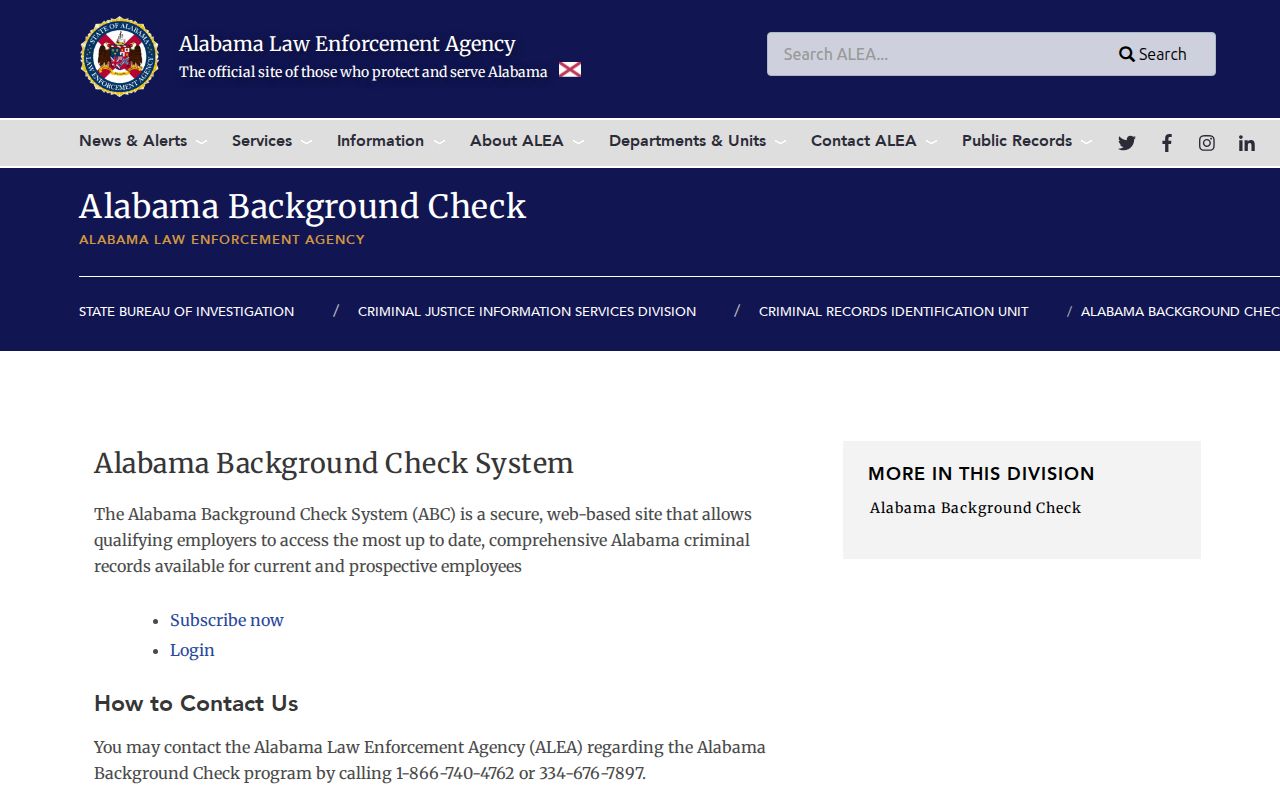
This state channel is broader than Madison County's self-check because it uses fingerprints to associate a person with repository events reported across Alabama.
Form 46 requests names and aliases, identifying traits, contact details, the request reason, identity documents, signature, and fingerprint-card information. A challenge requires the returned CHRI, each disputed arrest or disposition, the reason it is wrong, the proposed correction, and proof from the arresting agency or court. An FBI Identity History Summary is separate and subject-only. It answers what the FBI identification record contains, not what sits in a Madison County case file.
Wheeler Avenue County Record Check
The Sheriff's Criminal Records Division offers a Madison County-only check on the requester's own record for $10 cash, exact change. A current state-issued photo ID is required, and the sheriff lists about three business days for processing. It is useful for a local self-review, but it does not replace ALEA's statewide fingerprint-associated CHRI. The same counter provides fingerprint cards for $10 each, exact cash, from 9:00 a.m. to 3:30 p.m. on weekdays.
Incident reports use a narrower routine. A victim or complainant can obtain their sheriff incident report for $2 cash during the public-service day. Broader requests, third-party reports, 911 or CAD material, and video require direct contact with the records office. They may be redacted or withheld under Alabama law. The sheriff's online contact form is not an emergency channel and warns that email is not secure.
| Madison County record service | Fee | Key requirement |
|---|---|---|
| County-only self-check | $10 exact cash | Own record, in person, current state photo ID |
| Fingerprint card | $10 per card | Exact cash, photo ID, weekday fingerprint window |
| Victim or complainant report | $2 cash | Routine copy at the records counter |
| Non-routine request | Verify with office | Describe the incident, agency, date, and desired medium |
Note: A Madison County self-check is local in scope and cannot certify that no Alabama record exists elsewhere in the state.
Criminal Record Types
Madison County criminal history is made from records with different owners and purposes. An arrest report narrates an alleged event. A booking record documents jail intake. A charging record states what a prosecutor or grand jury filed. The court file tracks hearings, pleadings, rulings, outcome, and sentence. ALEA CHRI links fingerprint-supported arrest cycles with dispositions reported by courts. None of these records should be treated as a substitute for all the others.
- Incident and arrest records: created by MCSO, a city police department, a campus agency, or ALEA.
- Booking records: created at the Madison County Detention Facility with booking, charge, court, and bond fields.
- Court case records: kept by the Circuit Clerk or the municipal clerk that received the charge.
- Custody records: split among the county jail, ADOC state prison system, and federal Bureau of Prisons.
- Restricted records: juvenile, Youthful Offender, expunged, and protected victim information kept from ordinary public access.
A warrant is another distinct record. A judge or magistrate issues it, and law enforcement enters it for service. An unserved arrest warrant is not public merely because the surrounding case may later become public. Supervision records are also limited. A judgment can show probation, but officer notes, treatment data, and risk assessments are not presumed open.
Madison County Custody Record Layers
Custody status depends on where a person is held. The Madison County roster covers people in the county detention facility. After a sentenced person transfers to state prison, the ADOC Inmate Search is the proper current-custody tool. It accepts a six-digit AIS number or first and last name, caps a name search at 50 results, and omits historical and Youthful Offender information. Federal custody uses the Bureau of Prisons locator instead.
The Northern District of Alabama is the federal court layer for Madison County.
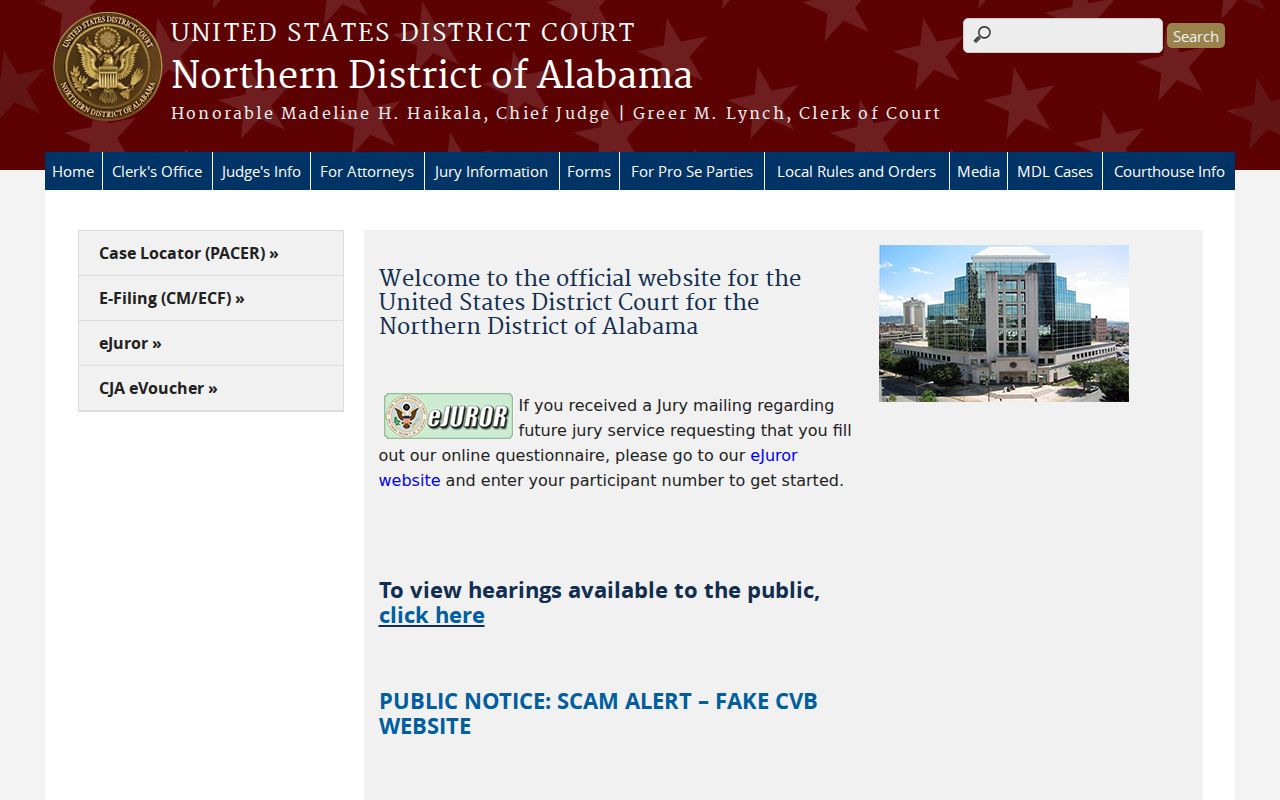
Federal criminal dockets use PACER rather than Alabama Just One Look, while federal inmate locations come from the BOP and not the Madison County jail roster.
| Custody layer | Official channel | What it answers |
|---|---|---|
| County | MCSO roster or 256-519-4800 | Current and recent local booking status |
| Alabama state | ADOC Inmate Search | Current ADOC imprisonment |
| Federal | BOP Inmate Locator | Federal custody and covered release records |
Inside a Madison County Criminal Record
A Madison County criminal record can identify a person, an event, a court case, or a custody episode. The meaning of each field depends on the source. A jail charge describes the allegation at intake. A court disposition gives the case outcome. An ALEA arrest cycle groups the fingerprint transaction, agency, charges, case reference, and reported disposition. Always read the record title and status before drawing a conclusion.
| Name & Identifiers | Legal name, aliases, date of birth, physical descriptors, and state or federal identifiers as law permits. |
|---|---|
| Arrest / Booking Data | Arresting agency, booking number and time, charge description, court, bond, and holds. |
| Charges & Statutes | Alleged offenses at arrest and the complaint, information, or indictment later filed. |
| Disposition | The result for each charge, such as dismissal, acquittal, guilty plea, or conviction. |
| Sentence | Custody, probation, fines, restitution, or other terms imposed after judgment. |
| Custody / Supervision | Current jail or prison status and the public portion of probation or parole information. |
Protected identifiers may be redacted from public views. An online docket may also contain fewer images than the clerk's file. When the exact outcome matters, obtain the judgment or certified disposition from the court that entered it.
Madison County Supervision Record Chain
Probation and parole do not share one open Madison County offender-name search. A court judgment is the first source for a probation sentence. Adult state probation and parole field supervision runs through the Alabama Bureau of Pardons and Paroles. The county Office of Alternative Sentencing and Release handles local pretrial release, community corrections, misdemeanor supervision, and other court-referral work. Detailed officer notes, treatment data, and risk assessments are not presumed public records.
The Alabama Bureau of Pardons and Paroles publishes agency, field-office, hearing, and current-year result information.
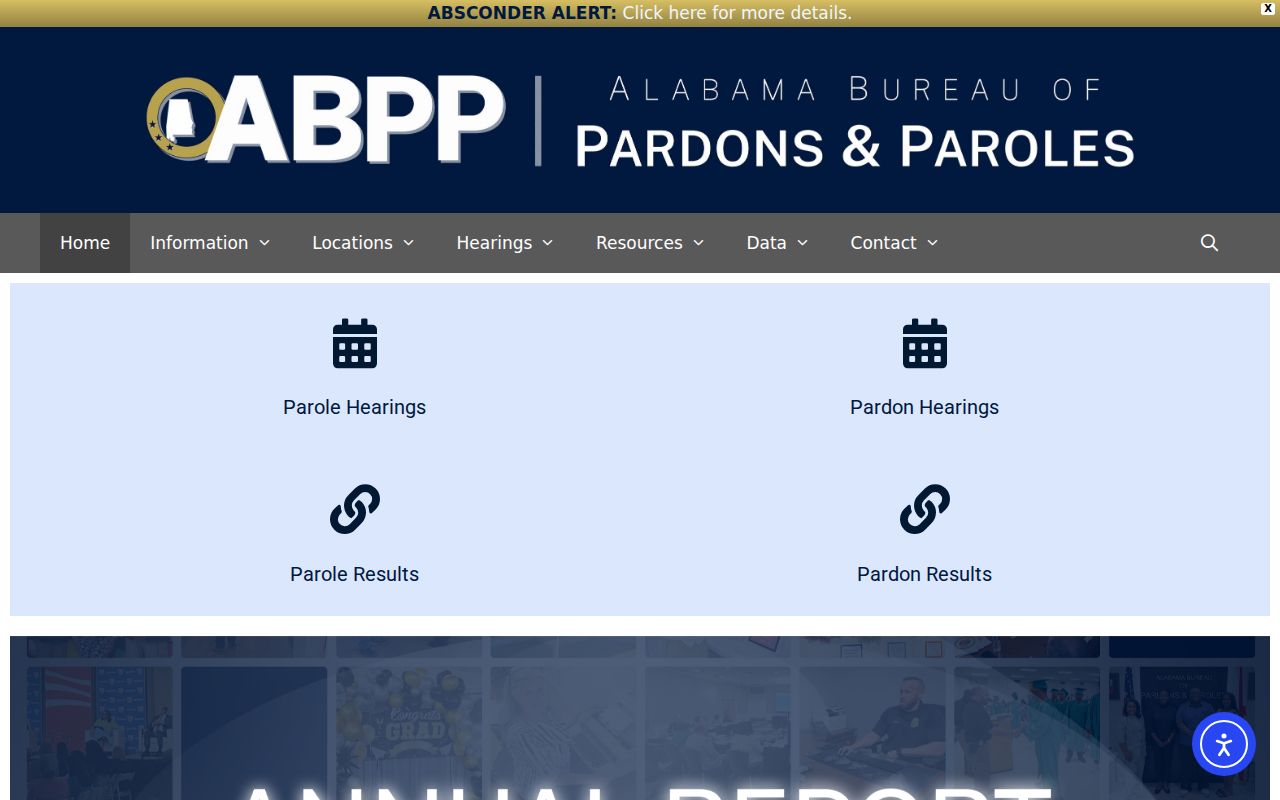
The Huntsville Field Office at 2801 Westcorp Boulevard SW can address the public status it may lawfully confirm, but it is not a general Madison County criminal-record lookup.
Madison County Criminal Record Terms
Madison County dockets and repository records use short legal terms that can change the meaning of a search result. A charge is only the alleged offense. The disposition is the outcome. A docket is the date-ordered list of case activity. These distinctions help prevent a pending allegation from being read as a final judgment.
- Arraignment
- The hearing at which the charge is presented and a plea is entered.
- No bill
- A grand jury declines to return an indictment on the submitted charge.
- Nolle prosequi
- The prosecution discontinues a charge. It is not a conviction.
- Disposition
- The recorded outcome of a charge or case.
- Capias
- A court process that directs an arrest, often tied to a pending case.
A dismissal ends a charge without a conviction, but it does not automatically remove every related arrest and booking entry. Expungement is the separate statutory process that can remove eligible records from ordinary public access after a court grants relief.
Public Access Laws in Alabama
The Alabama Open Records Act gives Alabama citizens a right to inspect or copy public writings unless another law makes the material confidential. Access still runs through the office that keeps the record. The sheriff releases its eligible reports and booking material. The Circuit Clerk provides state court files. ALEA provides a subject's statewide CHRI through its review process. Agencies may apply lawful exemptions, redactions, and reasonable access rules.
Key laws and rules:
Ala. Code § 36-12-40 provides the general right to inspect and copy public writings, subject to exceptions.
Ala. Code § 41-9-590 et seq. governs criminal-justice information and restricts access and misuse.
Alabama Rule of Judicial Administration 33 governs clerk searches, copies, and court-record fees.
Ala. Code §§ 15-27-1 through 15-27-21 set Alabama's expungement process and effects.
Ala. Code § 15-20A-1 et seq. governs registration, notification, and lawful registry use.
Active investigations, juvenile and Youthful Offender files, protected victim or minor details, security-sensitive information, and expunged records may be withheld. Public status never gives permission to threaten, harass, trespass, or misuse personal data.
Madison County Warrant Record Limits
MCSO does not publish a verified complete active-warrant name database. Its Most Wanted page is selective. Absence there does not prove that no warrant exists. Alabama's local rule is more important: an arrest warrant is not public until it has been served. NCIC is restricted to law enforcement, even though the Sheriff's Criminal Records Division enters warrants for Madison County courts and smaller municipalities.
The official Madison County Most Wanted page is a limited public notice channel.
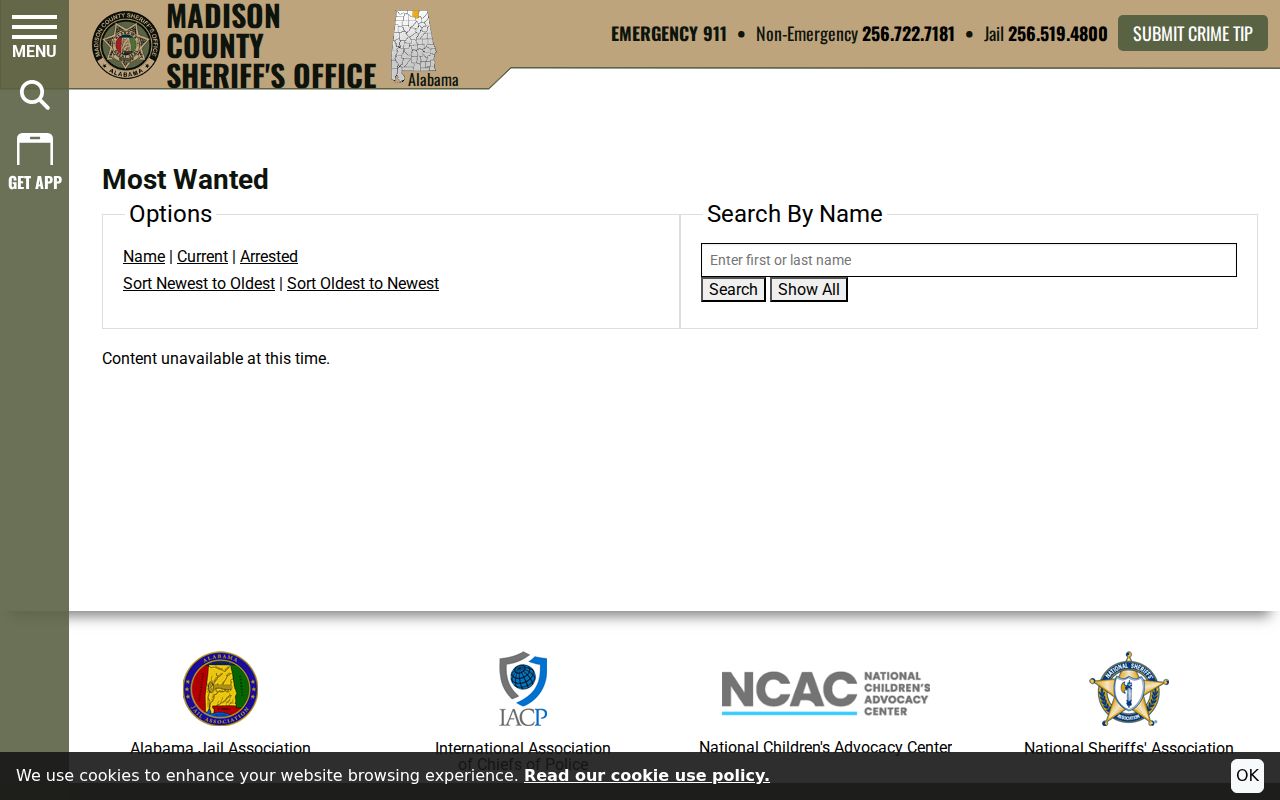
Because it is not a full warrant index, a person concerned about their own county warrant should contact the issuing court and follow the sheriff's direction to appear at the Wheeler Avenue annex.
The county Warrant Magistrate is in courthouse Room 217 at 256-532-3611, open 8:00 a.m. to noon and 1:00 to 4:30 p.m. Municipal paths differ. Huntsville Municipal Court and Madison Municipal Court keep their own warrant and bail channels. Identify the issuing court, ask about bond before appearing, resolve the underlying case or failure to appear, and then confirm that the court has cleared the process.
Sealed, Expunged, and Restricted Records
Alabama uses court-ordered expungement for specified arrests, charges, and convictions. It is not a broad automatic sealing system. Madison County petitions go through the Circuit Clerk Criminal Division in Room 217. The local forms require black ink, and the clerk cannot give legal advice. Eligibility can depend on the exact disposition, offense, time since completion, prior history, and whether all sentence and payment terms are complete.
A petition identifies the underlying case, charge, arresting agency, statutory ground, and every agency that holds a related record. It includes a certified ALEA record and certified arrest or disposition material. The statewide form lists a $500 filing fee, with one fee for multiple charges from the same arrest; separate arrests require separate fees. An available hardship form can address the administrative fee.
Juvenile and Youthful Offender files are not ordinary public adult records. Expunged material leaves normal public access but remains available in the limited situations Alabama law permits. Full birth dates, Social Security numbers, financial identifiers, protected addresses, and victim or minor information may also be redacted without sealing the whole file.
Correcting Madison County Criminal Records
If a dismissed Madison County arrest still appears, compare the court disposition with the booking record and ALEA CHRI. First obtain the final judgment or certified disposition from the clerk. If expungement was granted, confirm that the order names the sheriff, booking agency, ALEA, and every other record-holding entity. An office omitted from the order or service list may still retain its copy.
Next request a fresh ALEA self-review. Form 46 supports a formal challenge when the repository record has a missing or inaccurate disposition. Attach the returned CHRI and official proof, identify each disputed event, and state the correction sought. ALEA must verify the change with the source agency or court, so its challenge process does not carry the standard review request's four-to-five-week estimate.
Madison County advertised an expungement and voting-rights workshop on September 15, 2025. That was a dated local event, not a standing walk-in service. Current petitions and packets remain available from the criminal clerk. A signed order is the key document, but follow-through with each named agency is what makes the correction visible across the criminal-history trail.
Madison County Criminal Records by City
Huntsville, Madison, and Triana create city police reports and keep municipal court matters that do not move into the Circuit Clerk's felony lane. Their pages focus on each police records channel, local court, and booking route. County jail custody still runs through MCSO, while state felony and District matters remain with the Madison County courts.
Huntsville Criminal Records
HPD reports and Huntsville Municipal Court citations use separate city channels.
Madison Criminal Records
Madison Police publishes short-lived weekly reports and keeps records at Hughes Road.
Triana Criminal Records
Triana uses Town Hall, its request form, and a court with no online case search.
Madison County Court Record Transition
Madison County's courthouse square has served local justice since the first brick courthouse was completed there in 1818. The modern courthouse now holds the Circuit Clerk, criminal courts, District Attorney, and sheriff administration. Report copies, fingerprints, and the county-only self-check are off the square at Wheeler Avenue, while the nearby Service Center handles noncriminal functions such as licensing and probate.
That split may change. A 2025 feasibility study found that population growth and case load had strained the current courthouse arrangement. It compared a replacement on the existing square with a two-building approach and warned that construction on the square would require interim facilities. The county announced an architecture team for a courthouse replacement on March 13, 2026.
The Twenty-Third Judicial Circuit reported 12,072 Circuit Court filings and 29,341 District Court filings in 2024. Those are court workload counts, not crime totals or jail bookings. During the planned transition, call 256-532-3300 or the criminal clerk at 256-532-3386 before traveling for archived records, terminal access, or a specific counter. Current office locations remain the controlling addresses until the county posts a move.